
Winning Rural Precincts in a Congressional Race
In a big district, rural precincts can decide the race. How to find the ones that matter and reach voters spread across hundreds of miles is a challenge every candidate faces.
5 min read
Why rural precincts decide big districts
Here's the thing nobody wants to hear in a congressional district like ours: there's no town big enough to carry you. You win or lose a rural congressional race a few dozen votes at a time, in hundreds of precincts most campaigns never bother with.
That's why writing off the places you'll lose is such an expensive mistake. If you're going to lose a precinct 70–30, getting it to 64–36 still counts. Do that in fifty little precincts and you've moved as many votes as you would by winning a mid-sized town outright.
Oregon's 2nd District is about as big as it gets. It covers all or part of 20 counties (Hermiston Herald), and roughly 38% of its voters aren't registered with either party. In 2022, the Democrat lost by 35.1 points. In 2026, Chris Beck got that down to 23.3, mostly by showing up in precincts other campaigns and the incumbent had skipped for years.
A few things we'd want any rural campaign to understand going in. First, margin is everything; a vote you gain in a precinct you lose is worth exactly as much as one you gain where you win. Second, turnout is your real lever. A big review of 40 field experiments found campaign contact basically doesn't change who people vote for in a general election (Kalla and Broockman, APSR 2018), but it does get people who already lean your way to actually vote. And third, out here your biggest cost isn't doors. It's miles.
Finding the precincts that matter
We sort every precinct by two questions. How many of our likely supporters sat out the last election? And how many voters there split their tickets? Where both answers are high, that's where the doors go.
You'll need precinct-level results for the last two general elections and the last primary (include the top of the ticket, not just your race), plus registration and turnout by party for each precinct. It also helps to tag every precinct with its town and county, because you'll be cutting turf by place later and you don't want to rebuild that from scratch.
For the first question, take your party's registrants plus the non-affiliated voters who lean your way, and subtract the ones who voted last time. Work in actual numbers of people, not percentages. A precinct with 40 voters can look amazing on a percentage basis and still not be worth a three-hour drive.
For the second, look at how differently the same precinct voted for your party's strongest and weakest candidates in recent races. A big gap means people there are willing to cross over, and that's persuasion room.
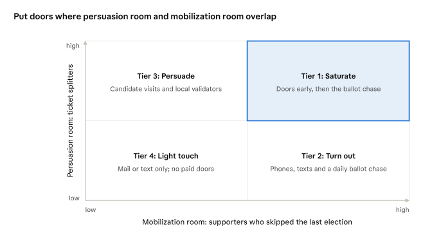
Tier 1 is where your paid or volunteer canvassers start. Tier 4 doesn't get paid doors, but don't forget it exists: those votes still count toward the margin, so keep it in your mail and text plans.
Choosing the voters inside them
Once you know which precincts matter, the question becomes who to talk to inside them. Our rule is simple: start with the people most likely to be with you who are least likely to vote.
In practice that means non-affiliated voters who lean your way come first. In most rural districts they're the biggest pool of votes nobody is chasing, and both parties tend to ignore them. Next are the harder-to-reach non-affiliated voters, the folks at the end of long gravel roads or without a working phone. Nobody else is going to visit them, which is exactly why a knock on the door means something. After that come the low-turnout members of your own party. They're already with you; they just need a reason and a reminder. Your reliable party voters are last. They'll vote anyway, so ask them to volunteer instead.
If you have a voter file, use its support and turnout scores and cut each list by precinct so a canvasser can work one town at a time. If you don't, you can still do this. Buy the voter list from the Secretary of State, score turnout from vote history, and estimate lean from each precinct's past results. Just be honest that it's a precinct-level guess, not a read on the individual.
Either way, clean the list before you print it. Bad addresses, PO-box-only records and people who've moved will eat a canvasser's whole afternoon.
Reaching voters across hundreds of miles
The single best thing you can do is hire people who already live there. A canvasser who drives two hours each way spends more of the day in the truck than on porches, and they don't know which road washes out in October.
We split the district into regional teams based on how people actually get around, usually a highway corridor or a valley, rather than county lines. Pay people a fair wage, reimburse their mileage, and schedule them on weekends when folks are home. In rural turf, 160 to 200 houses a weekend per canvasser is a realistic goal.
If most of a county's targets live in one town, base your canvasser there. Sometimes hiring a second person in a second town is cheaper than paying one person to drive between them. And lean on your county party chairs. They know the roads, they know the families, and they know who'll open up their living room for a canvass kickoff.
Cut walk lists by town and precinct, and put the rural addresses in driving order before anyone prints them. Have canvassers note gates, dogs and no-trespassing signs as they go so the next person doesn't make the same stop twice. When you go out to the far edges, plan a full day there instead of several short trips.
Doors aren't the only tool. Texts and calls work fine for in-town voters and for the final push to get ballots in, though most texts never get a reply, so don't count them as conversations. Ask your supporters to talk to five neighbors each; in a small town, a familiar name gets a door opened that a stranger can't. Show up where people already gather, like grange halls, county fairs, feed stores, sale barns and church dinners. And for voters who are homebound or can't get around easily, offer to pick up their ballot and take it to a drop box, done carefully within Oregon election law.
Timing it to Oregon vote by mail
In Oregon, Election Day is really a three-week window, and out here the mail is slow. By the last week, your whole job is getting ballots into drop boxes.
Oregon will count a mailed ballot that shows up as much as a week after Election Day, as long as it's postmarked on time (OPB). The catch is that rural mail can get sent to Portland for processing before it comes back to the county (KPTV), and late postmarks are a real risk.
Here's roughly how the calendar plays out:
- Summer into mid-September: recruit and train canvassers, cut turf, and start knocking in your top precincts.
- Three weeks out: that's the registration deadline (Ballotpedia), so wrap up registration work before then.
- When ballots land, two to three weeks out: stop persuading and start asking "have you voted yet?" Pull the ballot-returned list every day and take people off your lists as soon as they've voted.
- One week out: tell people to use a drop box or mail it today. The Secretary of State recommends mailing at least seven days early (Oregon SOS).
- The last three days: drop boxes only. Offer rides, or offer to deliver the ballot, for anyone who can't get to one.
- After Election Day: keep going. Help voters whose signatures were challenged fix them before the county's deadline.
Check the Secretary of State's elections calendar every cycle. The rules around postmarks and mail have been shifting.
Measuring what works
Rural canvassing doesn't run on city numbers. Doors per hour, cost per door and how many people you need to reach for each added vote all look different when the houses are a mile apart. We've measured those numbers on real rural Oregon field programs, and we're glad to walk any campaign through them.
Want help building your field plan?
This is the work we do at Westera: scoring your precincts, building your target lists, and putting local canvassers on the ground who know the roads. We'll tell you honestly what your race needs and what it doesn't.
Start with our free "Is my race winnable?" survey.
Checklist
- Precinct results for the last two generals and last primary, in one spreadsheet
- Every precinct placed on the persuasion / mobilization grid
- Target universes built and cut by precinct and town
- Regions drawn by travel routes; one local canvasser per region
- Rural walk lists sorted into driving loops
- Mileage, pay and schedule set before hiring
- Result codes for every door, including not-home
- Daily ballot-returned list from ballot drop to Election Day
- Drop-box map and ballot-delivery plan for homebound voters
- Post-election comparison of contacted vs. uncontacted voters
Further reading
- Kalla and Broockman, "The Minimal Persuasive Effects of Campaign Contact in General Elections" (APSR, 2018)
- Green and Gerber, Get Out the Vote: How to Increase Voter Turnout (Brookings)
- Green, Gerber and Nickerson, "Getting Out the Vote in Local Elections: Results from Six Door-to-Door Canvassing Experiments"
- Oregon Secretary of State elections calendar
Need someone to handle this for you? See Westera's services.